
Pontevedra Citizens' Climate Committee
Sixteen Pontevedra residents deliberated in five sessions in 2026 and drew up 12 food-related actions to reduce the municipality's climate footprint.
2026
Brief description of the action
The Pontevedra Citizens' Climate Committee was a citizen deliberation process carried out between March and June 2026. Sixteen local residents of different ages, backgrounds and circumstances met in five four-hour sessions to draw up practical recommendations that help reduce Pontevedra's climate footprint through changes in food consumption and in food-related public policies.
The Committee was part of the Plataforma ODS project, led by the Post-Growth Innovation Lab of the Universidade de Vigo with financial support from the Ministry of Social Rights, Consumer Affairs and 2030 Agenda and in collaboration with Pontevedra City Council. The Hidria team designed and facilitated the sessions together with the laboratory. The experience took as its reference the Spanish Citizens' Assembly for the Climate and adapted it to the scale of a municipality.
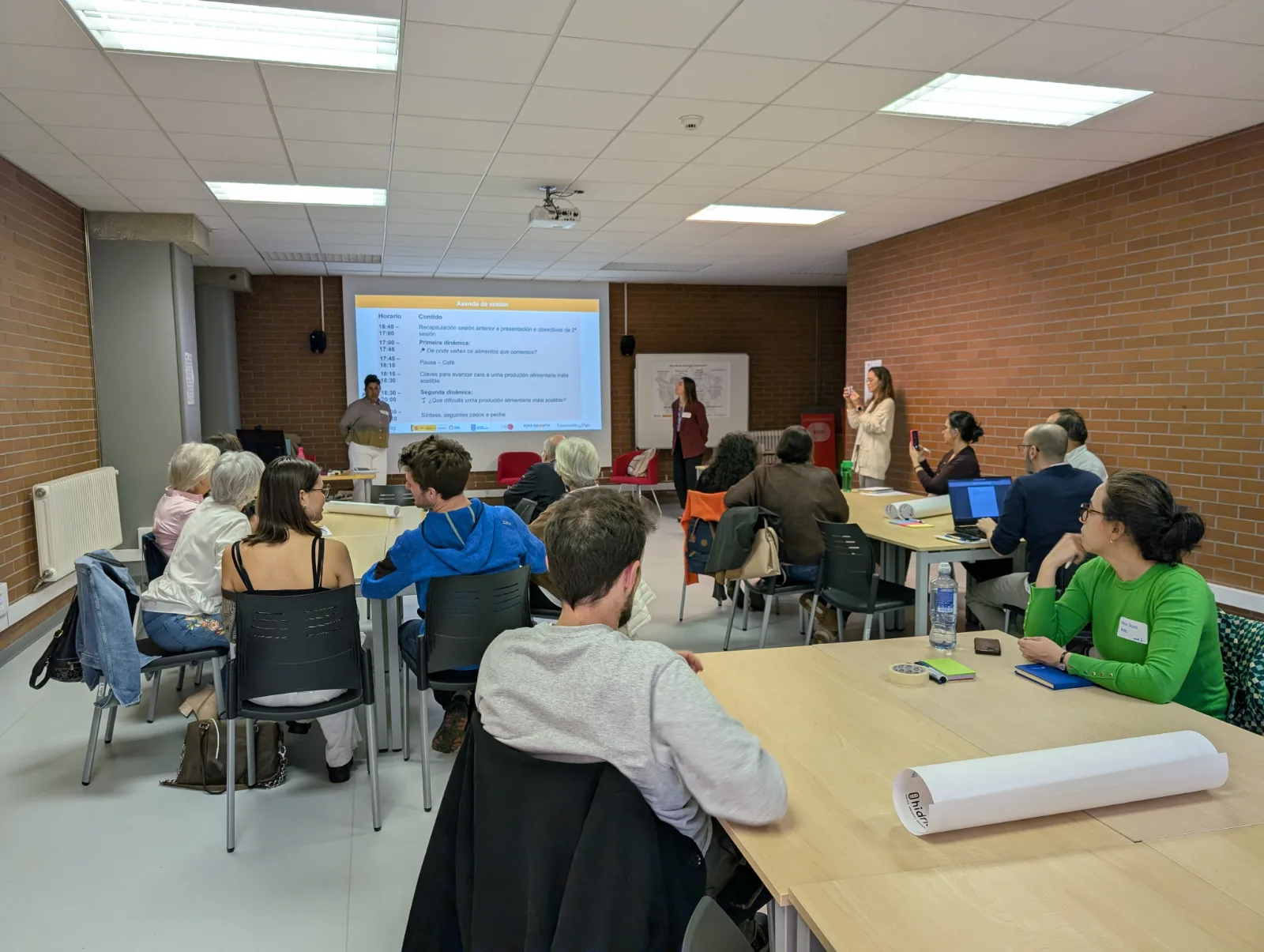
The sessions were held on weekday afternoons from 3 March to 30 June 2026, in Universidade de Vigo premises on the A Xunqueira Campus in Pontevedra and at IES Luís Seoane. Step by step, the group built a shared vision of a more sustainable Pontevedra in 2035, analysed how the food consumed in the municipality is produced, drew up 12 preliminary proposals together with students from IES Luís Seoane, turned them into 30 actions and developed the highest-rated actions in detail.
The result is 12 actions, each with a complete sheet, grouped into four thematic lines: short food supply chains, sustainable food in the school community, waste prevention, and spaces and infrastructure for a resilient local food system. The project presented these recommendations in public on 16 October 2026, and Pontevedra City Council undertook to assess them from an administrative and political perspective.
Context and objectives
The Committee was a working group of volunteers who analysed a public problem and drew up recommendations for the City Council. It sought to offer a welcoming space for meeting and dialogue in which citizens could design proposals, and it was a pioneering initiative in Galicia. It was deliberative, consultative, open and proposal-oriented: its conclusions guide the City Council without binding it, and from the first session the team made clear that it was a space for deliberation, with no activist role.
It took as its reference the Citizens' Assembly for the Climate, which arose from the Declaration of Climate and Environmental Emergency in Spain approved by the Council of Ministers on 21 January 2020. The Pontevedra Committee transferred that experience to the municipal scale as a pilot process, with a smaller group, fewer sessions and a single area, food consumption, which connects citizens' everyday lives with the municipality's emissions and with municipal responsibilities such as markets, school canteens or urban gardens.
The aim was to draw up practical recommendations that help reduce the climate footprint of the municipality through changes in food consumption patterns and policies. The specific objectives were to form a diverse and committed group, build a shared understanding of the climate challenge and the local food system, identify barriers and opportunities for more sustainable food consumption, formulate and prioritise actions, and develop the priority actions in order to pass them on to the City Council.
The Committee was part of the Plataforma ODS project, the Open Science Platform for the Local Promotion of the SDGs, which seeks to promote the Sustainable Development Goals at local level through the co-creation of evidence-based policies. Its pilot project in Pontevedra connected two actions: Postgrowth S.A.: Alimentación, in which students and teachers of IES Luís Seoane researched household food consumption, and this Committee. The two came together at the First Local Development Forum, where the results of the school research fed into the Committee's debate.
Organising, supporting and funding entities
The responsible institution was the Universidade de Vigo, through the Post-Growth Innovation Lab. The laboratory coordinated the Plataforma ODS project, validated the design of each session, supported the work at the tables with note-taking, photographic record and timekeeping, and organised the Local Development Forum.
Hidria, the consultancy team, was in charge of the recruitment and selection of Committee members, the methodological design of the sessions, the facilitation of the working tables and the session reports. Before each session, Hidria prepared a detailed programme with the objectives, the agenda, a description of each activity and the materials needed, and the laboratory reviewed and validated it. After each session, Hidria wrote a report with the methodology and the results.
In each session, the Hidria team facilitated the activities, guided the work at the tables, answered questions and made sure that the objectives of each activity were met. The Post-Growth Innovation Lab team spread out across the tables to support the work of the groups, and the two teams led the closing of each session together.
Pontevedra City Council was the partner institution and the recipient of the recommendations. A representative took part in the forum and a councillor reviewed the actions in the fourth session. IES Luís Seoane was the venue of the First Local Development Forum, where its students and teachers presented their citizen science research and worked with the Committee.
The process was funded within the Plataforma ODS project, with financial support from the Ministry of Social Rights, Consumer Affairs and 2030 Agenda. The School of Forestry Engineering, the Faculty of Public Management and IES Luís Seoane hosted the meetings.
Participant recruitment and selection
The call for participants was publicised through several channels and those interested registered through a questionnaire. Members were selected at random from among the people who registered, so the composition of the group depended on who came forward.
The consultancy team phoned the selected people to explain the project, its scope, the deliberative nature of the Committee and the planned structure of the sessions. In that conversation it confirmed each person's real interest and availability, looked for the most suitable date for the first session and asked how each person had heard about the initiative, in order to evaluate the dissemination channels. Once the group was complete, each person received a message confirming their participation with the date, time and venue of the first session.
The Committee was made up of 16 people, 9 women and 7 men. The group was intergenerational, with one person aged 18 to 30, five aged 31 to 45, six aged 46 to 65 and four over 65. Nine people were in work, three were retired, three were unemployed and one indicated another situation.
Three people had secondary education, from vocational training or upper secondary school, eight had university degrees and five also had a master's degree or a doctorate. The group was gender-balanced and intergenerational, but the call mainly attracted people with a university education, and young people were under-represented despite the outreach efforts.
Methods and tools
The work was organised in four phases, from understanding the problem to defining concrete actions: formation and shared vision, learning and deliberation, deliberation and generation of proposals, and synthesis and final definition. Each session produced materials that served as the starting point for the next. The four-hour sessions took place on 3 and 24 March, 28 April, 21 May and 30 June 2026, on the A Xunqueira Campus of the Universidade de Vigo and at IES Luís Seoane in Monteporreiro.
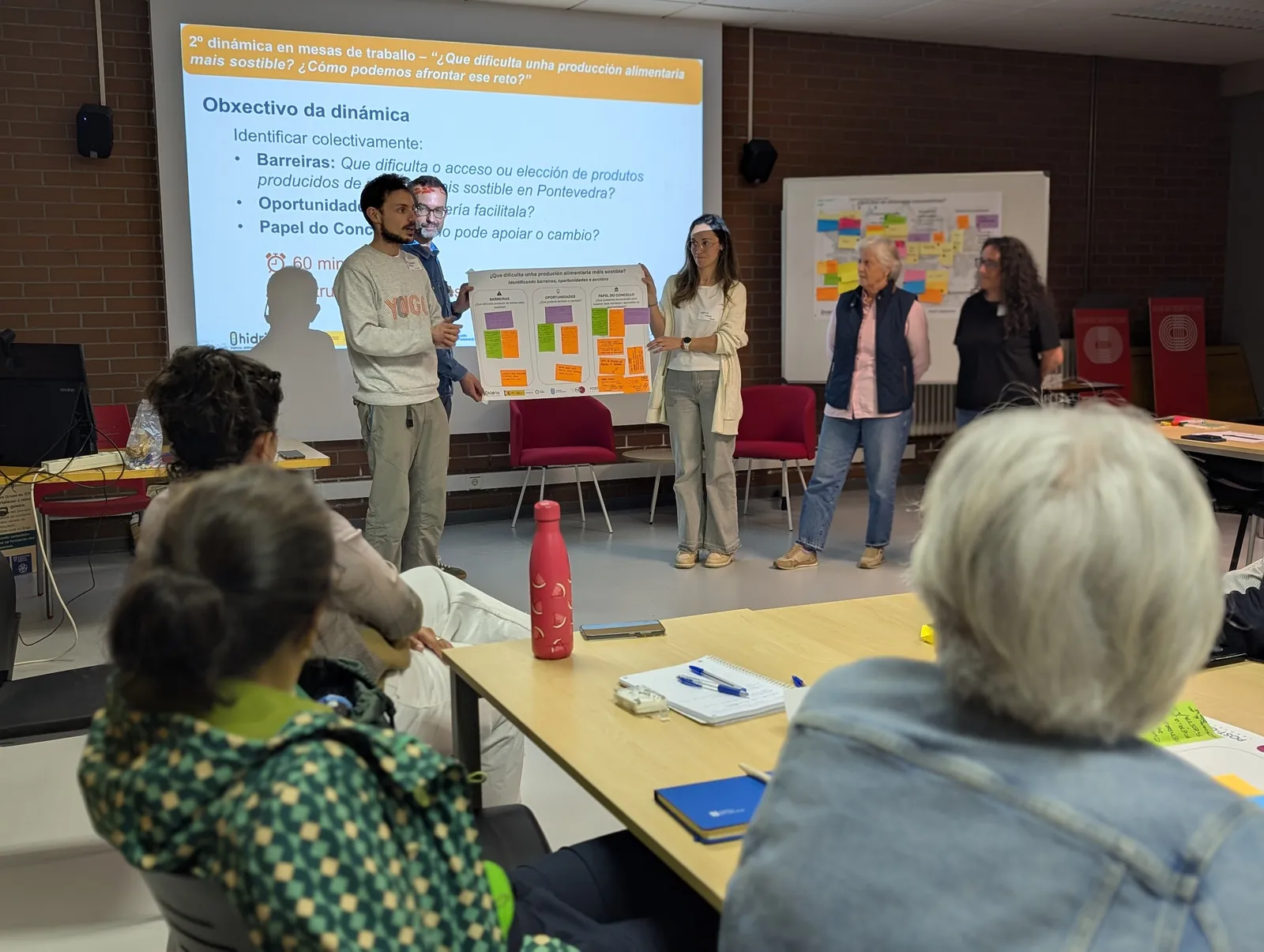
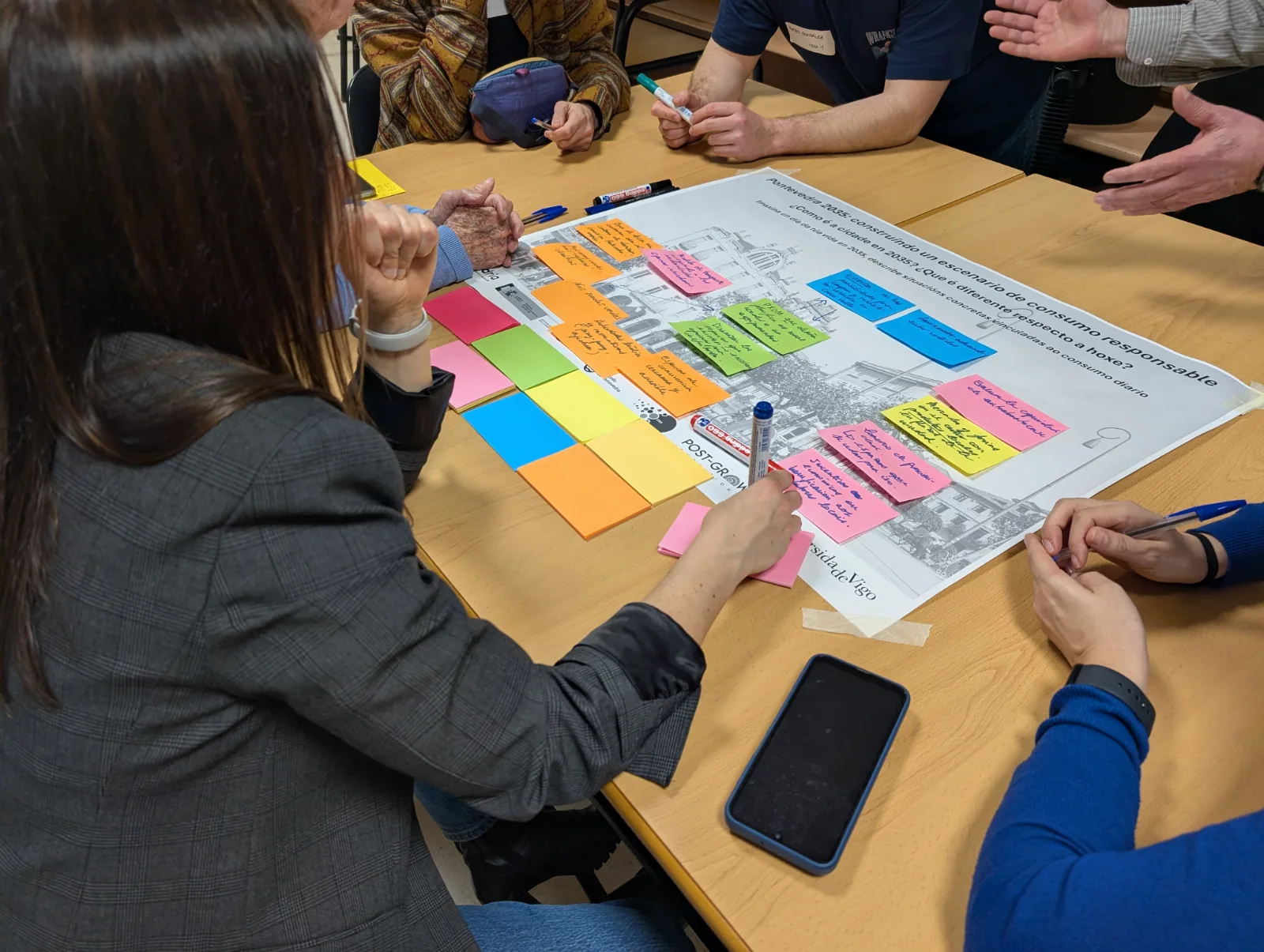
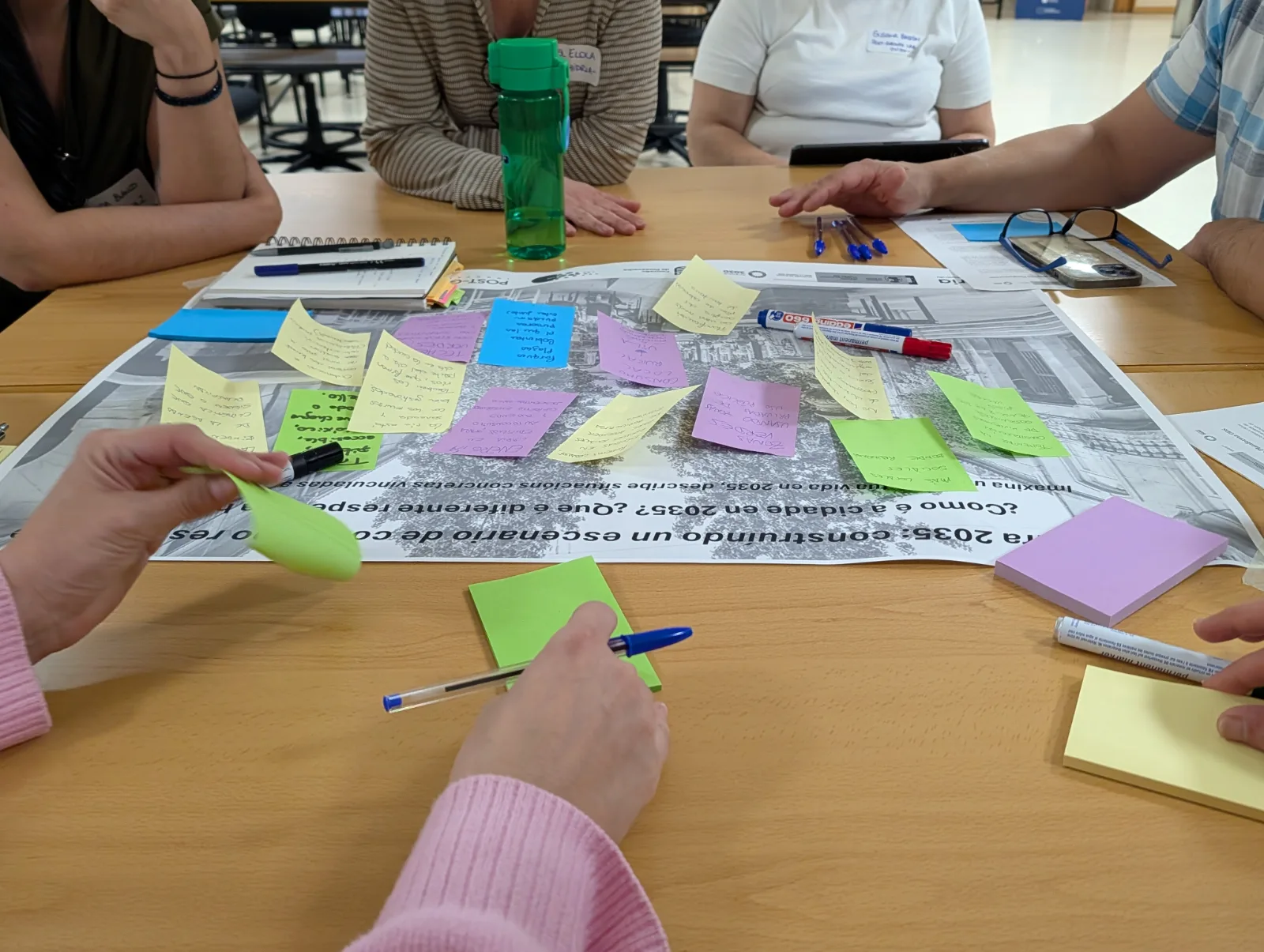
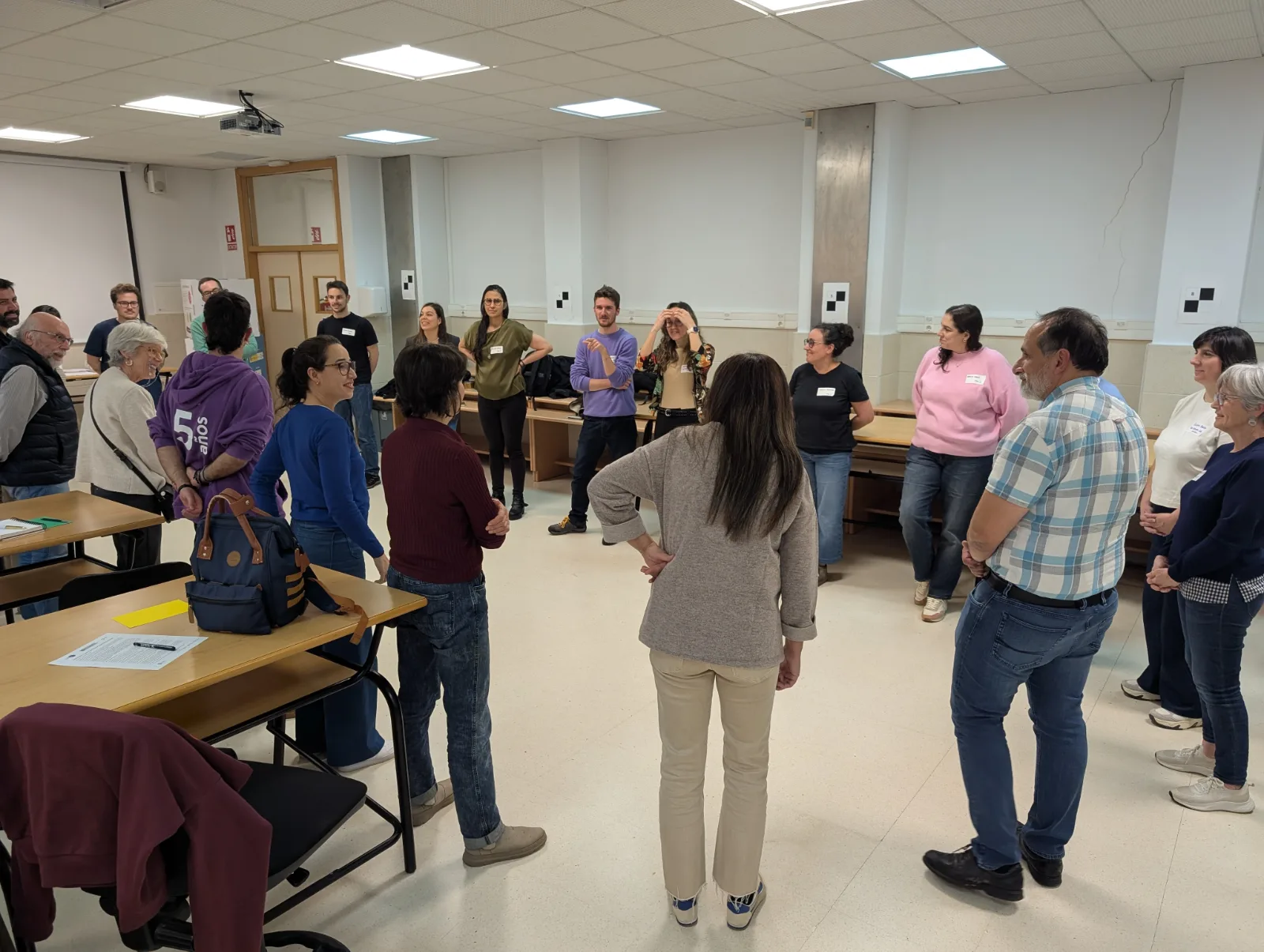
The first session set up the Committee with introduction activities, a first snapshot of the climate challenge with the real-time tool Survey123 and a future visioning exercise, Pontevedra 2035, after which the team focused the process on food throughout its whole life cycle. The second analysed how the food consumed in Pontevedra is produced, rated the origin of everyday foods with coloured dots and identified barriers, opportunities and the role of the City Council. The third, held alongside the First Local Development Forum, built on the students' research to formulate proposals at four challenge stations, vote for the 12 with the most support and complete their needs and barriers.
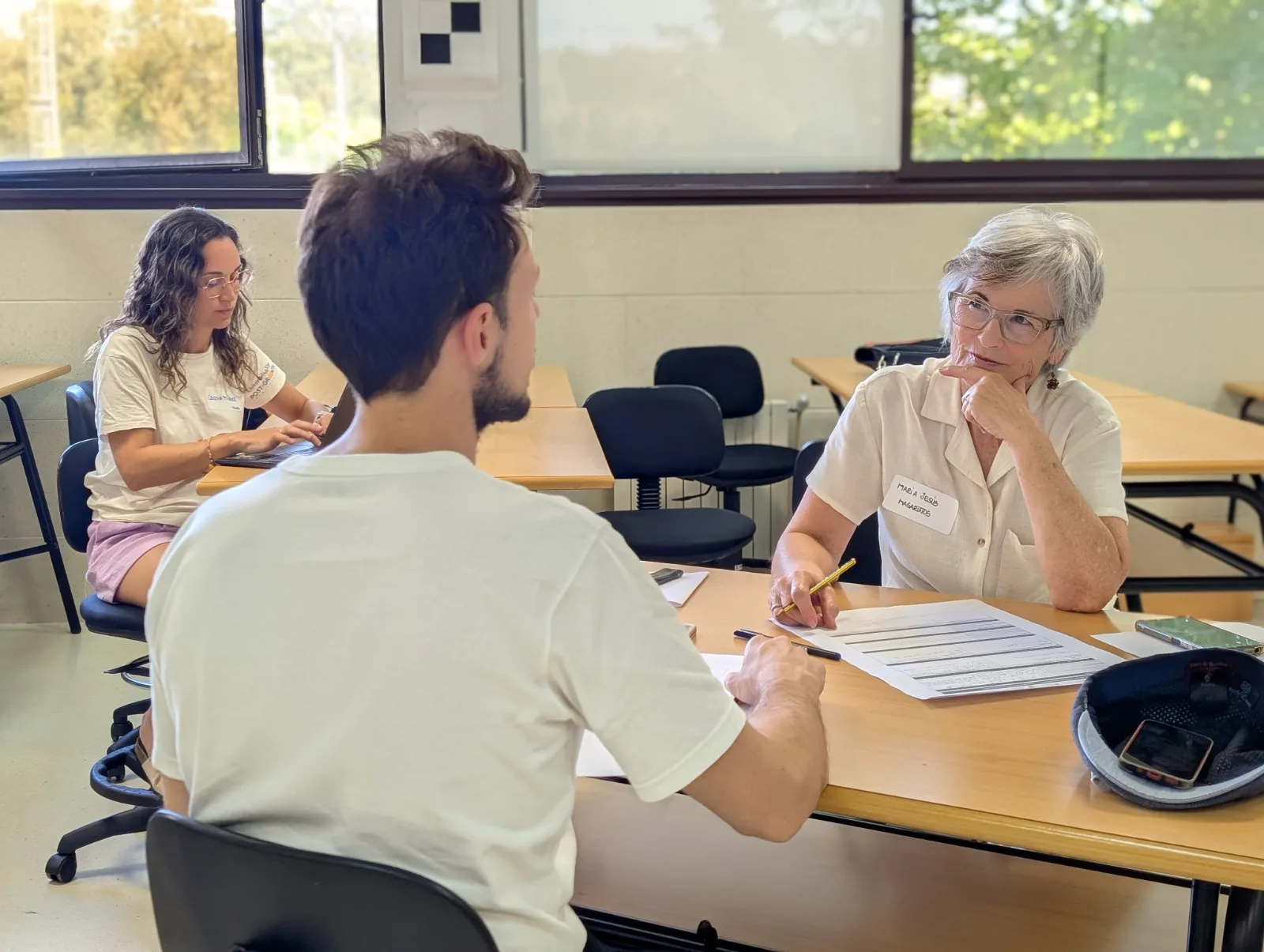
In the fourth session, three groups turned the proposals into 30 actions, scored them against environmental, institutional, economic and social criteria and discussed them with a councillor. Before the fifth, two questionnaires prioritised the actions and assigned one to each participant, who developed it through paired conversations in a speed dating format, followed by a presentation and a validation with coloured stickers.
The group used a messaging channel for operational use only, the sessions included a coffee break and the organisers provided a bus for the forum session. Committee members received financial compensation according to the number of sessions they attended and, after the sessions, a summary version of each session report.
The process met the Universidade de Vigo requirements for research involving people and personal data, including the protocol of its Ethics Committee (CEISHMA), the General Data Protection Regulation and Spanish Organic Law 3/2018. Participation was voluntary, each person signed an informed consent form, the data were stored in the institutional cloud with restricted access and the results are disseminated in aggregate form.
Outcomes
The process worked like a funnel, from broad perceptions of climate change to 12 municipal actions. The 12 preliminary proposals of the third session became 30 actions in the fourth, which were synthesised into 28 and prioritised by questionnaire, with 15 selected. In the fifth session 12 action sheets were developed, because three of the people assigned an action were unable to attend.
The Committee's final report, dated July 2026, orders the 12 actions according to the priority the group gave them and groups them into four thematic lines. Each action has a sheet that details the actors involved and their role, the resources needed, the first steps, the time frame, the monitoring indicators and its relationship with other actions.
The first line, short food supply chains and connection between production and consumption, includes taking the market outside the market, street stalls selling local produce around the Mercado de Abastos, activities that bring producers and consumers together, support from the administration for direct experiences and boxes of local and seasonal produce at affordable prices. The second, sustainable food and education in the school community, covers local produce and on-site cooking in school canteens and education programmes on food and sustainable consumption.
The third line, waste prevention and use of surpluses, promotes tools for making use of food surpluses and the analysis and dissemination of good practices on food waste. The fourth, spaces and infrastructure for a resilient local food system, proposes improving the Mercado de Abastos and redesigning and expanding the network of public urban gardens in different neighbourhoods.
The process also left reusable materials, such as the session programmes and reports, the document of preliminary proposals, the action sheets and the prioritisation questionnaires. The complete sheets are in the Committee's final report, available on the TIAS lab website.
Impacts
At the end of each session, participants rated it on an evaluation target with four aspects: the interest of the content, the opportunities to take part, the atmosphere of collaboration and the usefulness of the workshop. The first session was well received, the second obtained a positive rating with answers concentrated in the centre, and the fourth was rated very well for the opportunity to express oneself and the usefulness of the workshop, with somewhat lower, though still positive, scores for the atmosphere of collaboration and the interest of the content.
The group maintained its commitment over four months of voluntary work in the afternoons, and 12 of the 16 Committee members attended the fifth session. One person gave advance notice that they could not attend and three others did not attend in the end, so the actions assigned to those three people were left undeveloped.
The assessment of the objectives found that forming a diverse group and building a shared understanding were partly achieved, that identifying barriers and opportunities was achieved and that formulating and prioritising actions was achieved, with high technical demands. Developing the actions and passing them on to the City Council was largely achieved, with 12 complete sheets, a final report and a public presentation, but only partial collective validation.
On 16 October 2026 the Plataforma ODS project presented its results in public at the Casa das Campás in Pontevedra, at an open event that was also streamed live. The presentation included the Committee's recommendations and a round table on how citizens' assemblies connect with the decisions of the administration.
Pontevedra City Council is committed to assessing the measures from an administrative and political perspective and to seeing which ones it can put into practice. The Universidade de Vigo, through the Post-Growth Innovation Lab, will monitor the recommendations and keep up communication with citizens and with the people who made up the Committee.
Lessons learned
The Committee fulfilled its main purpose: in five sessions a group of local residents drew up concrete municipal actions, the City Council undertook to assess them and the process was presented in public. The quality of the deliberation, however, had clear limits. Differences in knowledge between participants, an abstract start, overly technical tasks and facilitation that did not always balance the voices meant that some people carried more weight than others in the outcome.
What worked included the City Council's commitment, the presence of a councillor at the fourth session, a progressive sequence in which each session prepared the next, the connection with citizen science, the variety of activities, the questionnaires before the last session and the group's commitment. Participants also received summaries of the sessions and, at the end, the Committee's report.
As for what should be improved, the process did not include common initial training, and the short presentations in the first two sessions were not enough to level the starting point. The focus on food was set only at the end of the first session, at several points the group was asked to do work that was too technical, and the agendas proved too dense for four hours, so two planned activities could not be completed.
The call mainly attracted people with a university education, three absences left actions undeveloped and there was no clear moment of agreement on the 12 recommendations as a whole. The report also points to the risk that the syntheses reflected the team more than the group, institutional input that came only in the fourth session, a shared session in which the mix of profiles, languages and paces made it harder to go into depth, and the lack of any record of a final evaluation of the process.
For future editions, the report recommends common initial training, a clear topic and expected result from the call for participants, tasks that ask citizens for experience, priorities and criteria, and facilitation that balances the voices. It also recommends agendas with spare time, a broader call, final sheets worked on in pairs, syntheses returned to the group with a final document approved together, information from municipal technical staff from the start and a final evaluation with participants.