

Navigating circular economy imaginaries
A co-creation action navigating alternative circular-economy imaginaries through a serious game.
2024
Brief description of the action
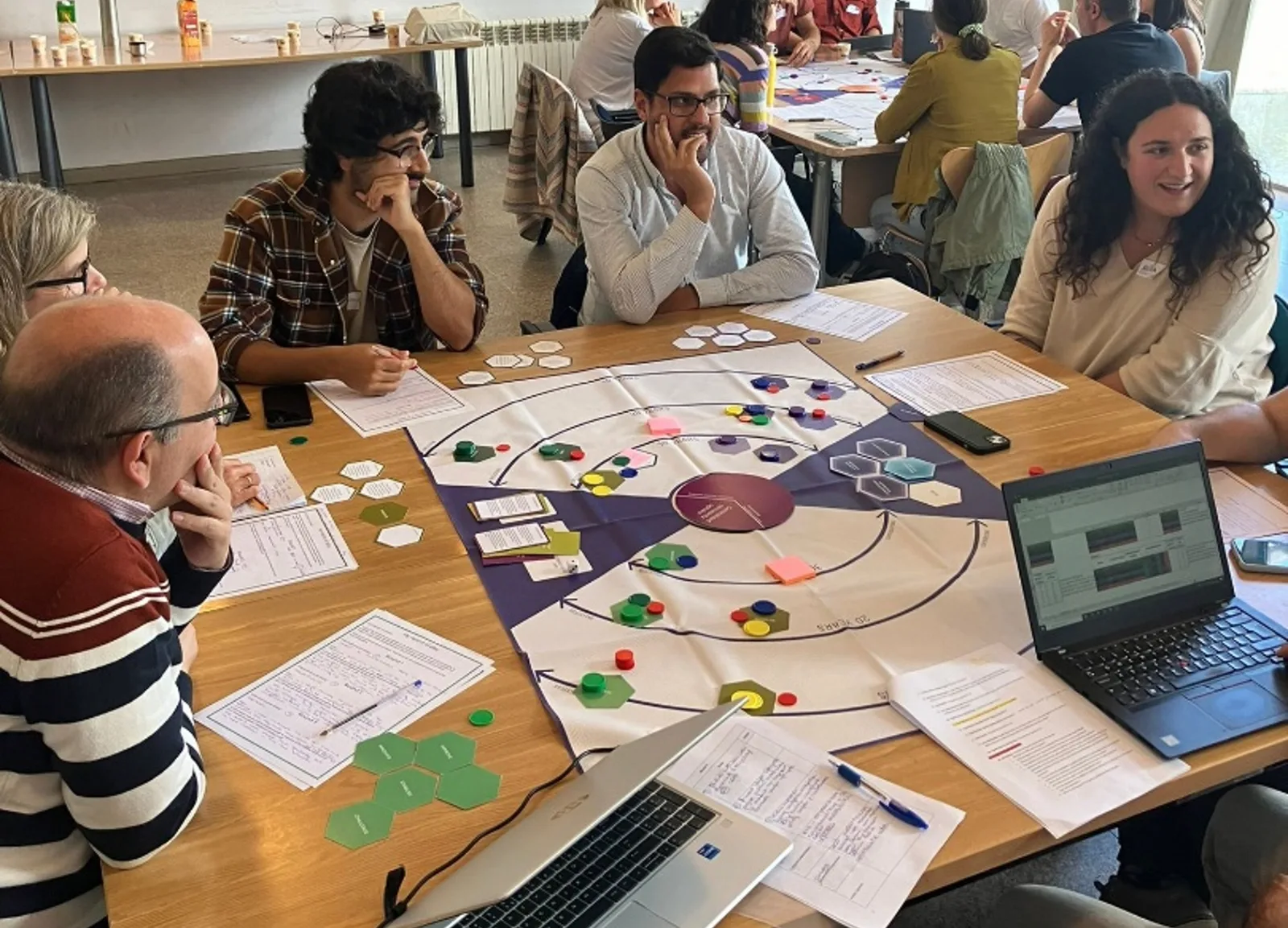
The ExPliCit workshops are participatory foresight sessions that explore how different forms of circular economy may develop in the future. They use a serious game that allows participants to enter alternative future scenarios, take on the role of a social actor and decide how to respond to changing conditions.
The action brings together people from public administration, business, research and civil society. Participants explore how different actors can influence circular transitions and how their decisions, resources and collaborations shape possible pathways.
The workshops take place in Brussels and Pontevedra. The Brussels session brings a European perspective, while the Pontevedra session focuses more closely on Galicia and its regional context. Together, the two sessions involve 38 participants.
Context and objectives
The circular economy is often presented as a single model for reducing waste and keeping products and materials in use. In practice, very different circular economies are possible. They can be led by governments and large companies or organised through local communities and smaller organisations. They can also support continued economic growth or give priority to ecological limits, sufficiency and social equity.
ExPliCit develops four contrasting scenarios based on these differences. The action uses these scenarios to move beyond general descriptions of the future and explore what different actors may actually do within them.
The main objective is to encourage participants to think strategically about the conditions and pathways that can lead towards different circular futures. The workshops also examine how actors use their capacity to act, how they respond to unequal resources and how cooperation and public acceptance affect the direction of change.
A further objective is to collect knowledge from the discussions and decisions that emerge during the sessions. This evidence supports research and policy debate on the circular economy and helps to understand how circular pathways can be negotiated and shaped in practice.
Organising, supporting and funding entities
The workshops form part of ExPliCit, which stands for Exploring Plausible Circular Futures. The project is coordinated by the University of Naples Parthenope and brings together universities, companies, consumer organisations and business and civil society networks from several European countries.
The Academy of Business in Society organises the Brussels workshop. The University of Vigo organises the Pontevedra workshop through the Post-Growth Innovation Lab. Researchers from the University of Seville and other ExPliCit partners also support the facilitation, observation and documentation of the sessions.
The Brussels workshop draws on the networks of the Academy of Business in Society. The Pontevedra workshop forms part of the European Society for Ecological Economics conference, which helps to connect the action with researchers and organisations interested in sustainability and ecological economics.
ExPliCit receives funding from the European Union through the Horizon Europe Marie Skłodowska-Curie Staff Exchanges programme. The participation of the University of Sheffield is supported through the UKRI Horizon Guarantee programme.
Participant recruitment and selection
Participation is open to people interested in the circular economy and sustainable futures. The recruitment process combines public registration through Eventbrite with direct invitations, distribution lists and communication through the networks of the project partners.
The organisers seek a varied group rather than a statistically representative sample. Invitations aim to bring together people from public administration, established companies, small and medium-sized enterprises, research institutions, consumer organisations, environmental groups and other civil society organisations.
The Brussels workshop attracts participants from European institutions, international businesses, business associations, universities and civil society networks. The Pontevedra workshop includes more actors connected with Galicia, including local companies, foundations, research organisations and organisations linked to maritime activity, recycling, social enterprise and regional development.
Before the session, participants provide information about their experience and professional background. The organisers use this information to form balanced groups and assign roles that are reasonably close to the participants’ knowledge, while still giving them space to interpret the role and imagine its priorities. The process therefore remains open to interested participants while maintaining the multi-stakeholder character needed for the exercise.
Methods and tools
The action uses a circular economy version of the Scenario Exploration System. This is a serious game originally developed by the European Commission’s Joint Research Centre and adapted by the ExPliCit consortium.
The game explores four circular futures. Two scenarios maintain a focus on economic growth and two give priority to ecological limits and social equity. Two rely on centralised decision-making and two are based on more decentralised and bottom-up forms of governance.
Participants work in small groups. Each person takes on the role of an established business, a small or medium-sized enterprise, a policymaker, a non-governmental organisation, a consumer organisation or the public voice. A trained facilitator guides the process and a note-taker records the main actions, discussions and negotiations.
Each group explores two contrasting scenarios over three future periods covering ten, twenty and thirty years. Participants define their values and long-term aims, choose actions and decide how many limited resources to invest in them. From the second round onwards, they can also support and collaborate with other actors.
The public voice evaluates the proposed actions by allocating influence tokens. Its support can increase the effect of an action, while a lack of support can reduce it. This makes social acceptance an active part of the exercise rather than a topic that is only discussed afterwards.
The game uses a board, scenario descriptions, role sheets, action cards, contextual drivers, resource tokens and influence tokens. Pre-workshop surveys, game records, structured observation, debrief discussions and post-workshop questionnaires provide additional information for the research.
Outcomes
The action generates a detailed record of how different actors respond to contrasting circular futures. It captures the actions they prioritise, the resources they invest, the partners they choose and the level of support their proposals receive from the public voice.
The findings show that the scenario context changes the influence and room for action available to each participant. Centralised scenarios tend to make regulation and large-scale investment easier to pursue. Decentralised scenarios create more space for local experimentation and coalition building, but they also bring greater coordination challenges.
Participants usually respond through practical adaptation. They try to find actions that are possible within the conditions of the scenario rather than immediately attempting to transform the whole system. Their capacity to act is not fixed, however. It develops as the game progresses and as participants respond to other actors and changing conditions.
Collaboration often emerges when different actors can align their interests. It is less common for participants to give up their own priorities entirely for a shared objective. The workshops also show that public acceptance plays a central role in determining which strategies gain support and which pathways remain politically and socially viable.
The action produces workshop reports, game data, qualitative observations and policy reflections. It also contributes to scientific research on foresight, circular futures, agency and the direction of sustainability transitions.
Impacts
The workshops help participants develop a long-term and systemic view of the circular economy. Instead of discussing circularity only through isolated technologies or business practices, they examine how governance, economic priorities, power and public legitimacy interact.
Role play encourages participants to consider viewpoints that may differ from their own. It also creates a structured setting for negotiation between public institutions, businesses and civil society. This can support learning about the responsibilities, limitations and possible contributions of different actors.
The action makes abstract future scenarios easier to explore. Participants experience how the same decision can have different effects depending on the wider political and economic context. They can test strategies without facing the risks associated with real-world decisions.
The evidence generated through the workshops informs academic and policy discussions about circular transitions. It also supports the development of a reusable circular economy edition of the Scenario Exploration System, which can be applied in other places and with other groups.
Lessons learned
The experience shows that serious games can make complex future scenarios understandable without removing their political and social tensions. The combination of roles, limited resources and changing conditions encourages participants to make choices rather than propose every desirable action at once.
Good facilitation is essential. Participants need a clear explanation of the scenarios and rules, but they also need enough freedom to interpret their role, negotiate and respond creatively. Note-taking is equally important because many of the most valuable findings emerge from the reasons, disagreements and negotiations behind each action.
A varied participant group improves the discussion by bringing together different forms of knowledge and experience. At the same time, group composition can influence the results. Existing relationships, professional backgrounds and familiarity with the topic may affect how easily people collaborate and how confidently they defend a position.
The public voice is one of the most valuable parts of the method. It makes social legitimacy visible and shows that technically feasible actions may still fail when they lack public support. However, one person cannot fully represent the diversity of public opinion, so this role needs to be interpreted as a stimulus for discussion rather than as a complete measure of social acceptance.
The workshops also show that collaboration does not automatically mean that actors work towards the same public interest. Cooperation is often based on compatible individual objectives. The debrief therefore needs to examine not only whether participants collaborate, but also why they collaborate and whose interests the resulting pathway serves.
Finally, scenarios provide an initial direction, but they do not completely determine the result. Participants can adapt, build alliances and change the course of the exploration. This makes the tool useful for studying futures as processes that are continually shaped through interaction rather than as fixed destinations.